Thursday, January 14, 2016

Final Project: The effect of culture on Schizophrenia
By: Janet Rodriguez

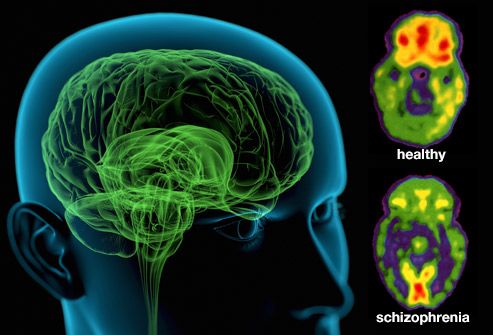
            Schizophrenia is a serious mental disorder that affects about 1% of the world population. Schizophrenia alters the way people think, feel and act. Individuals often have difficulty distinguishing between was is real and what is not real. They are also often unresponsive and may have difficulty expressing normal emotions in social situations. The symptoms of Schizophrenia appear most often in young people between the ages of 13-25. For young males, schizophrenia can be detected earlier than females. Warning sign often include hearing and seeing things that aren’t there, a constant feeling of being watched, a change is personality or hygiene appearance, inability to sleep or concentrate, increasing withdraw from social situations and inappropriate or bizarre behavior. The cause of this particular disease is still unclear. Some suspected causes of this disease include: genetics, biology, and/or viral infections and immune disorders. Schizophrenia is not caused by poor parenting, childhood experiences, or lack of will power like many people think it is. People with Schizophrenia are not violent and dangerous to others as many people think they are. The signs of this disease are different for everyone and may develop slowly over months or years, or they may appear all at once. Recent studies have found out that Schizophrenia affects people differently based on their cultural background.
            A group of scientist at the World Health Organization studied the differences between people with schizophrenia in developed and developing countries, trying to find out if culture played a role in the development of the disease. The final results showed that the symptoms and prognosis of the disease differed from country to country. In more industrialized nations the disease is generally more severe than in developing countries. This is believed to be true because in developing countries, illnesses are believed to be caused by a type of supernatural force, therefore there is no reflection on the diseased person.
            Schizophrenic patients have tend to have delusions that reflect the themes and values of that certain individual’s culture. For example, a person with Schizophrenia from Ireland would have delusions of sainthood, because religious piety is valued. The delusions for patients in America tend to focus more on sinister uses of technology and surveillance. Some patients might report that they are being spied on by their televisions or that they are being x-rayed as they walk down the street. In Nigeria mental illnesses are believed to be cause by evil spirits, therefore the delusions may take the
form of witches or ancestral ghosts. In Japan, patient’s delusions revolve around slander or the fear of being publicly humiliated because the Japanese prize honor and social conformity. Many behaviors that would be seen as schizophrenic symptoms to the Western world, are considered are seen as spiritual delight in developing countries. If a person claimed he was a god on earth, he would be called delusional in western society but if he did that in India, he would be considered a spirit medium who is the human incarnation of a Hindu god. See the difference? Along the same lines, in African cultures, hallucinations are not always a sign of a mental disease. Shamans, who are tribal priest, act as intermediaries between the natural and the spiritual worlds. They are deeply respected for their abilities. These beliefs are cultural norms for some people and are not considered to be delusions.
A Shaman


Check out the video below for more information:


Sources Cited (MLA Format)
"Cross-Cultural Variance of Schizophrenia in Symptoms, Diagnosis and Treatment." GU Journal of Health Sciences. N.p., n.d. Web. 13 Jan. 2016.
"Hallucinatory 'voices' Shaped by Local Culture, Stanford Anthropologist Says." Stanford University. N.p., n.d. Web. 13 Jan. 2016.
PBS. PBS, n.d. Web. 13 Jan. 2016.

"Schizophrenia." Mental Health America. N.p., n.d. Web. 13 Jan. 2016.

Monday, January 11, 2016

Mexico City Earthquake in 1985
By: Janet Rodriguez
Hotel Regis (before)
On September 19th, 1985 at around 7:19 a.m., Mexico City had a powerful earthquake that caused a
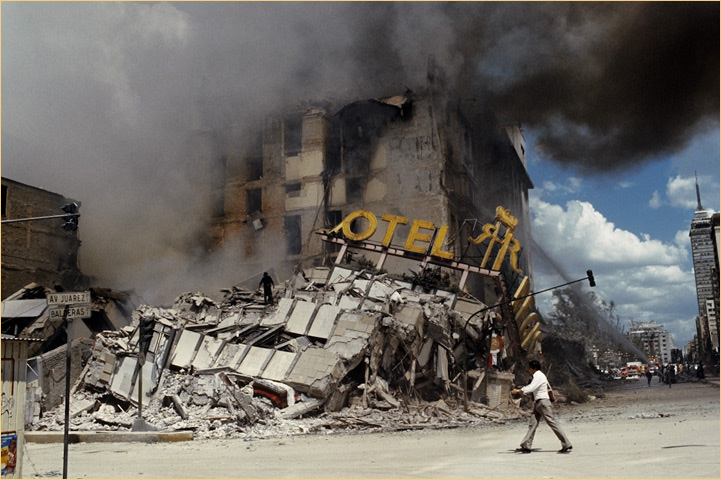
Hotel Regis (after)
significant amount of damage with a magnitude of 8.1. This was one of the strongest earthquakes to ever hit the area. The Earthquake was centered off the pacific coast of Michoacán, Mexico. Michoacán Is more than 200 miles away from the city of Mexico and most of the damage was done in Mexico City. Mexico City is known for being built on top of a lake bed by the Aztecs. Therefore you can imagine how much damage an earthquake could cause to the city due to its soft sediments that amplify seismic waves. After an earthquake in 1957, the government issued the first of the building codes with respect to earthquake resistance. However these regulations did not have in mind the power of the 1985 earthquake.


Apartment complexes (before)
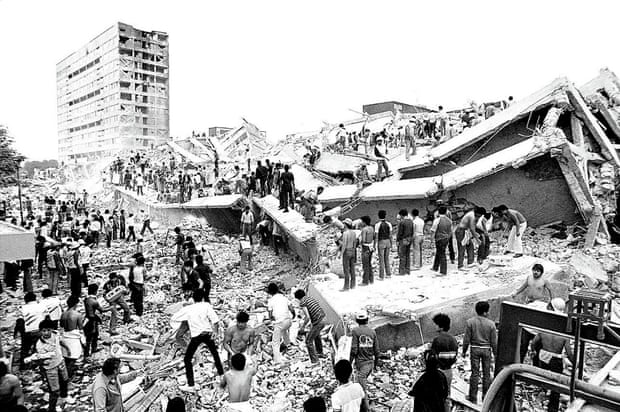
The quake was said to be felt all the way in Huston, Texas and Guatemala City, Guatemala. That was over an area of 319,000 square miles. The earthquake killed more than 10,000 people and caused 30,000 of them to get injured. About 25,000 people were left homeless due to the demolition of apartment building and houses. Thousands of buildings were damaged and more than 400 buildings in the city collapsed. To make things worse, on the evening of the next day an aftershock shook the region with a magnitude of 7.5.

Apartment complexes (after)
After all seeing all the damage, everyone in the city started to help getting people who were stuck, feeding people who were hungry and they formed their own rescue teams. They decided to do it all on their own because of the slow response of the Mexican government. The president at the time was Miguel de la Madrid. He was viciously criticized for the Mexican government’s slow and weak response to the natural disaster that occurred. The president had rejected international aid offers and said that there wasn’t a lot of damaged caused by the earthquake, which clearly was a lie. The disaster also helped expose that due to government corruption, the enforcement of building codes were not being applied. The total cost for the recovery
of the city was between 3-4 million dollars. After this disaster in Mexico City the Civil Protection Committee was created. The committee organized drills with rescue workers, police officers, hospital staff and metro personnel. An early-alert earthquake warning system has also been established in Mexico City, as well as other safety measures, as a result of the devastating earthquake of 1985.


Here's a video with more information:


Sources:

Tuesday, December 22, 2015

Juvenile Life Imprisonment without Parole
By: Janet Rodriguez

Many teenagers in the U.S. have been sentenced to life in jail without the opportunity to get parole. Each year, children as young as 13 years old in the United States are being sentenced to spend their life in prison without the opportunity of parole. In the United States. Approximately 2,500 juveniles are sentenced to juvenile life without parole. This notion is upsetting many child advocate groups as well as families. In the 1990’s, many states passed a new legislation specifically aimed at “Superpredators,” a type of teenage criminal known for being impulsive and remorseless. From 1992 to 1999, almost every state approved this legislature facilitating courts to punish juveniles as they would punish adults. Juveniles accused of murder, or other similar crimes, would mandatorily be sent to adult court. Adults convicted of murder would automatically be sentenced to life in prison without parole in many states, which would mean juveniles would also face this punishment. However, many cases like Miller vs. Alabama and Jackson vs. Hobbs, cause the Supreme Court to reconsider and in 2012 the Supreme Court ruled that juveniles accused of murder could not be mandatorily sentenced to life imprisonment without the possibility of parole.
Juvenile life in prison without parole has been debated back and forth over the years with people listing pros and cons endlessly. People who are pro juvenile life with no parole often say that a crime is a crime. If a person commits a crime, doesn’t matter the age, they will most likely do it again. Many also argue that in order to protect the public from any harm, they need to incarcerate violent and delinquent juveniles.
Most people however, don’t think that juveniles should be sentence to life in prison without parole. The most common used protest is that it is a violation of the 8th amendment, no cruel and unusual punishment. People also state that juveniles should be punished less harshly because they are very impulsive and are easily persuade under peer pressure. Their brains are not fully developed and neither are their personalities. Locking them up would not allow them to become a part of society and that could be potential thrown away. Many of them are considered to still be developing physically, mentally and emotionally, therefore they do not have the same culpability as adults do and should instead be offered treatment in the criminal justice system. Many also believe that if you sentence a juvenile flexibly, they will start to think about the long-term consequences of behaving badly in prison and be motivated to want to do better whenever they are released again into society. In my personal opinion, I feel that juveniles should not be sentenced to life without parole. This doesn’t necessarily mean that they should be let out scotch free.
I feel that they should be left in prison for a short term and then have the option of parole. After all a crime is a crime, and how else would you teach them that what they did was wrong. It’s like training a little kid from right and wrong, it just can’t go ignored. I agree with the argument that most juveniles are impulsive and are often persuaded to do certain things because of their friends and/or adults. They might feel that they fit in better or that they will suddenly become more likable to others. Juveniles also have a really low tolerance, which will most likely cause them to lash out, even at the smallest, insignificant thing. The most sentences of life without parole have been in states where judges are obligated to impose it as a mandatory sentence, without any consideration of the child’s age or life circumstances. The majority of the youth being charged with life without parole are from just 5 states: California, Florida, Louisiana, Michigan, and Pennsylvania. More than 25 percent of people serving life without parole were convicted of accomplice liability. Juveniles being sentenced to life without parole are often the most vulnerable people in society. Nearly 80 percent have witnessed violence in their homes and/or been physically abused. African American Juveniles are sentenced 10 times more frequently to life in prison without parole than white Americans.


 For a more in depth perception of this topic watch the following video. 


Works Cited:

Friday, October 30, 2015


Wave Power
By: Janet Rodriguez

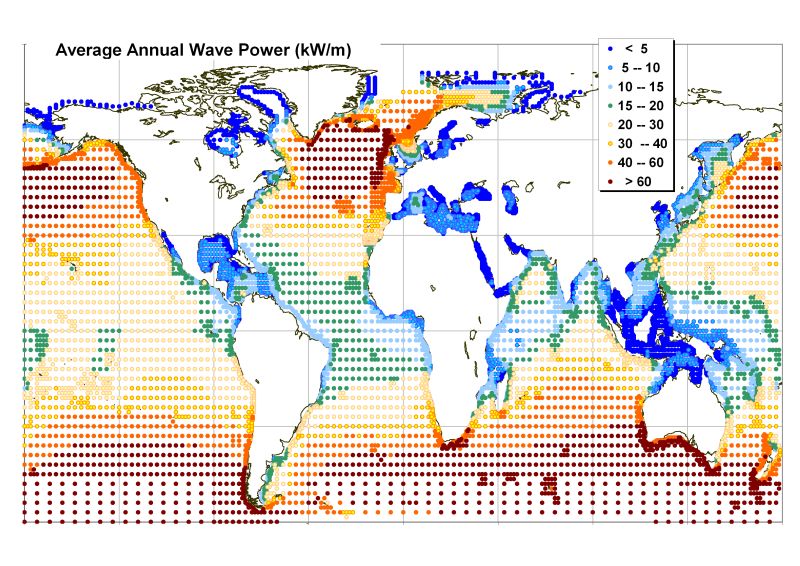
Wave Power is the transport of energy by ocean surface waves, and capturing that energy to do useful work like electricity generation, water desalination, or the pumping of water into reservoirs. The machine used to exploit wave power is known as a wave energy converter. People have tried to widely employ this form of technology since 1890 and have been unsuccessful. The first experimental wave farm was opened at the Agucadoura Wave Park, in Portugal, in 2008. The way this form of energy generator works is straight forward and very reasonable. The waves produced by the wind contain energy that transferred from the wind to the waves. However, energy will only be present if the waves made are slower that the speed of the wind. In order for this type of energy generation system to work there needs to be wind, waves and some sort of energy absorber. Energy absorbers include an Oscillating Water Column, a Surface-following Attenuator (Line Absorber), or a Buoyancy Unit/Point Absorber. All of these energy absorbers include different ways into converting the wave energy into electricity. 
Some side-effects to wave power include that they are very costly, noisy and could harm the marine life. Many people that live on where wave power plants are located, complain about the amount of noise that is produced. When starting a wave power plant the costs are really high and a risk if the plant doesn’t succeed. The energy absorbers cause many problems with different species. Birds and other animals are always running into them and getting injured or dying. The PTC provides a tax credit for the production of electricity and the profit of that electricity to an unrelated party. The movement and distribution of this energy is not to complex. The height and speed of the wave are recorded and the amount of energy that comes out would be in units known as Kilowatts (kW).  

Wave Power cannot be used of grid because of its complex energy conversion. It could be useful for transportation, if you need to charge something electrical. Like a scooter, car, etc. This type of energy has a centralized system. All of the power relies on the waves. Without waves energy wouldn’t be able to turn into electricity to produce power.


There are many obstacles for this form of energy generation to be adopted. The initial cost to start a wave power station in very expensive. The machines are also expensive to repair, fix and maintain. And sea life can end up getting really affected by them. People also say that they are too noisy and drive people away from the location. The government could go observe the wave power stations in Brazil and see how they work. They also see their efficiency, qualities and how much is produced. I feel that if they see how effective and enhancing this come of energy conversion is, more people will start to adopt it.  


Sources Sited:

https://www.youtube.com/watch?v=gcStpg3i5V8
http://e360.yale.edu/feature/why_wave_power_has_lagged_far_behind_as_energy_source/2760/ 
https://en.wikipedia.org/wiki/Wave_power


Check out this video for more information:


Friday, October 9, 2015


San Diego’s “Frozen Zoo”
By: Janet Rodriguez

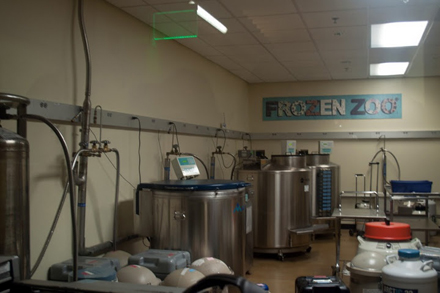
Tubes in which skin cells are kept
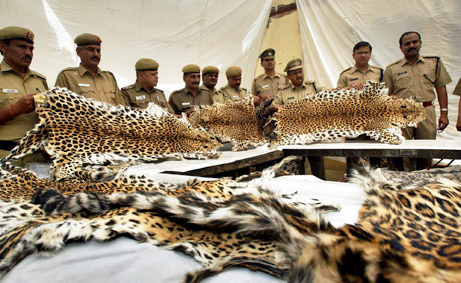
                For years many animals have been extinct, or on the border of being extinct, thanks to the humans species. Human Kind is very ambitious and selfish, thanks to this many other species have suffered the consequences. Animals are often hunted down by poachers for their unique characteristics. Elephants are often killed for their tusks, tigers for their fur and Rhinos for their horns. Many groups of people and organizations have started to take action in stopping this issue, one of them is the San Diego Zoo. 
Consequences of poaching
The San Diego Zoo in California has been working on a project since 1972, to try to help these animals and many others from becoming permanently extinct. The Zoo began to collect skin samples from rare animals in 1972, scientist hoped that these animals would be protected in the future were science would be more advanced. They made a good choice in doing so because that stem-cell technology is getting closer. The Frozen Zoo has more than 8,400 animal skin cells that represent more than 800 different species. The skin cells are kept in deep freezers (metal boxes filled with liquid nitrogen) with temperatures of -280 degrees Fahrenheit. The San Diego Zoo is not working alone on this project, Scripps Research Institute have been taking skin cell 
samples from the Frozen Zoo and turning them into stem cells. Stem cells as you may know, are undifferentiated cells in an organism that can change into other kinds of cells, like blood cells, skin cells, etc. After turning them to stem cells, they can be converted into sperm or egg cells. These cells could then be used to form an embryo and allow reproduction to occur. The Frozen Zoo will help us keep our interaction with animals and allow us to have the privilege of experiencing nature more effectively. Many people would like to see rare animals, making the San Diego Zoo really popular and busy. The Frozen Zoo would bring more money into the country, because not only will Americans come see the animals but so will other interested people all over the world. 
Where the Skin Cell tubes are kept
The Frozen Zoo has already made an impact on society. Many endangered animal have been relocated into the zoo for protection. The Zoo also has skin cells from already extinct birds, which allows them to be studied and help scientist gain more information. From these skin cells they can see what might have led to their extinction and help prevent other species from becoming extinct. The Frozen Zoo can also help animal species from becoming permanently extinct in the future. There are however some side-effects to this project, which many people use to stop this certain project. The Frozen Zoo tries their best to help out animals from extinction, but many argue that though they could recreate animals they can’t stop poachers from hunting them down. Another side-effect is that this type of technology requires a little bit more time, they’re still trying to come up with the best way to reproduce the animals. So this project may still require a little bit more time, but as genetic technology advances so will the project. 


For more information watch the video below:


Sources:
 http://www.sandiegozooglobal.org/what_we_do_banking_genetic_resources/frozen_zoo/ 
http://recode.net/2014/02/13/to-preserve-and-protect-how-a-frozen-zoo-is-helping-to-save-endangered-species/ 

Friday, October 2, 2015


The Globalization of the Selfie
By: Janet Rodriguez

A selfie is a self-shot photo, usually taken with a mobile phone and posted online to social media sites.  The selfie is one of the most common pictures taken and posted on social media. (Mainly Instagram; Instagram is considered the home of the selfie) Right now there are about 40,000,000 pictures up on Instagram with the #selfie. That’s not including #selfies, #selfiesunday, #selfienation, #selfiee, #selfiesfordays, etc.. In January of 2013 it wasn’t even on the top 100 tags used on Instagram. The usage of the hashtag selfie was first seen on Flickr in the year 2004, but it took about a decade to finally reach its highest popularity point. In the year of 2013, the selfie began to gain popularity and fame on google search. The first recorded selfie was taken biochemist and metallurgist, Robert Cornelius, in 1839. When famous people started taking selfies and posting them, fans all over the world started to post their selfies as well.

Robert Cornelius (1839)


The global spread of the selfie has brought many problems to the social media world. There are people that view individuals who take selfies as narcissists. It’s mainly the women who are often viewed this way. There are individuals that feel that females who take selfies and post them on social media are only doing it for the attention of men. There are also people who view women taking selfies as a way to break stereotypes on women. Many times women are expected to be these perfect, beautiful and classy individuals, according to the male perspective. Cynthia Wade, a filmmaker and creator of a film called “Selfie,” says, “We spend so much time trying to hide our flaws because the culture has set it up that you have to be ashamed if you’re not perfect. I think girls are tired of it.” People like her view selfies as a way to celebrate ourselves and our imperfections/flaws. Psychologists believe that young adults take selfies as a way of finding who they are and their true identities. However, they also fear of how influential selfies are on the emotional health of teenagers. Many believe that the comments and likes on a selfie could lower/ rise a person’s selfie esteem. The lowering of self-esteem is obviously bad because it could lead to depression or illnesses. Most people view the rising of self-esteem to be good, so how can that be bad? The rising of self-esteem is good but to a certain limit. When a person’s self-esteem is high, they could end up becoming narcissists. Researchers have discovered that people who post a lot of selfies online, because they feel beautiful, have scored high on measures of psychopathy.


            Selfies have affected the whole world in many ways. The selfie has because extremely popular in the United States and has already influence the country’s social media. Many famous people in the U.S. post selfies daily and they make sure they look absolutely stunning. When fans see this they want to look as flawless as they do. This has brought a lot of money into the Plastic Surgery business in the United States. China has also seen how much selfies have gained popularity in their country as well. Recently a Chinese manufacturer unveiled his plans for a new smartphone with instant facial beauty support software, so that the consumers’ selfies come out flawless every time. Selfies have had a huge impact on the world and will continue to affect it in the near future. 


Watch this video for more information:


Sources: 

Wednesday, September 2, 2015

Felon Voting By: Janet Rodriguez~
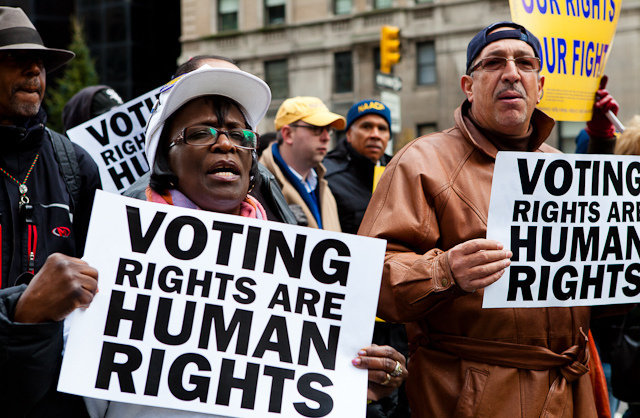
  Disenfranchisement is the condition in which people with felonies are not allowed to vote in elections. In states like Vermont and Maine felons are allowed to vote while in prison, while nine states permanently restrict felons from voting. The idea of taking away a criminal’s right to vote has been around since ancient Rome and Greece. It’s part of a condition known as “Civil death”. “Civil death” in Europe involved the loss of the right to appear in court, loss of property and the loss of voting rights. “Civil death” was brought to America when the English colonist arrived. The majority of its aspects were however abolished and only felon disenfranchisement still exists today in modern America. Many people however, do not agree with this voting restriction.

A felon’s judgement is an area in which people do not trust when picking a leader for the country. The Pro side to felon voting, argues that if we let ex-convicts drive, buy beer, reproduce and marry, why not vote? If people thought criminals could never change their ways and reform themselves, they would not let them out of prison in the first place. The people against felons voting argue that they cannot be trusted with picking a leader out for the country because they have proven with their actions that they are not trustworthy. And that like children, non-citizens and mentally incompetent people are not allowed to vote they should not be either.


Some people use the Eighth Amendment in order to allow felons to vote. The eighth amendment prohibits excessive sanctions and demands that the punishment for the crime should be proportioned to the offense. This means that states that exclude all felons permanently are out liars to both the U.S. and the rest of the world. Other people use the fourteenth amendment, which contain felon disenfranchisement laws. And that only the only those with racially discriminatory purpose are unconstitutional. The argument that allowing prisoners to vote could be costly is unjustifiable. Prisoners already lose a lot of freedom and rights, but that doesn’t mean that they should lose all of their civil rights. By allowing prisoners to vote, may help them come back into society and commit to the common good. Many people argue that the main point of a prison sentence is to show that when a crime is committed, the consequences result in a total loss of freedom and rights.
In my personal opinion. I feel that felons should not be denied the right to vote. Yes, they made a mistake but that doesn’t mean that they should be deprived of participating in such a huge event. Individuals are always encouraging people to vote and say that there should be more people voting, yet they are against felons voting. The simple fact that they want to vote shows that they actually do care about what happens in the Country and that they want to do what’s best for it. Many people who are allowed to vote might not even care and just vote because they want to follow the crowd. And if there is someone in jail who actually does care, why not allow them to. Sure they made a mistake, but who hasn’t? That’s why I think that felons should be allowed to vote after and while in prison.

Check out this video for more information!

Sources:
http://www.ncsl.org/research/elections-and-campaigns/felon-voting-rights.aspx
http://felonvoting.procon.org/view.resource.php?resourceID=000283
https://exoffenders.net/felon-voting-rights/